Thought Leadership
The number the West should be worried about is zero.
5 Aug 2026
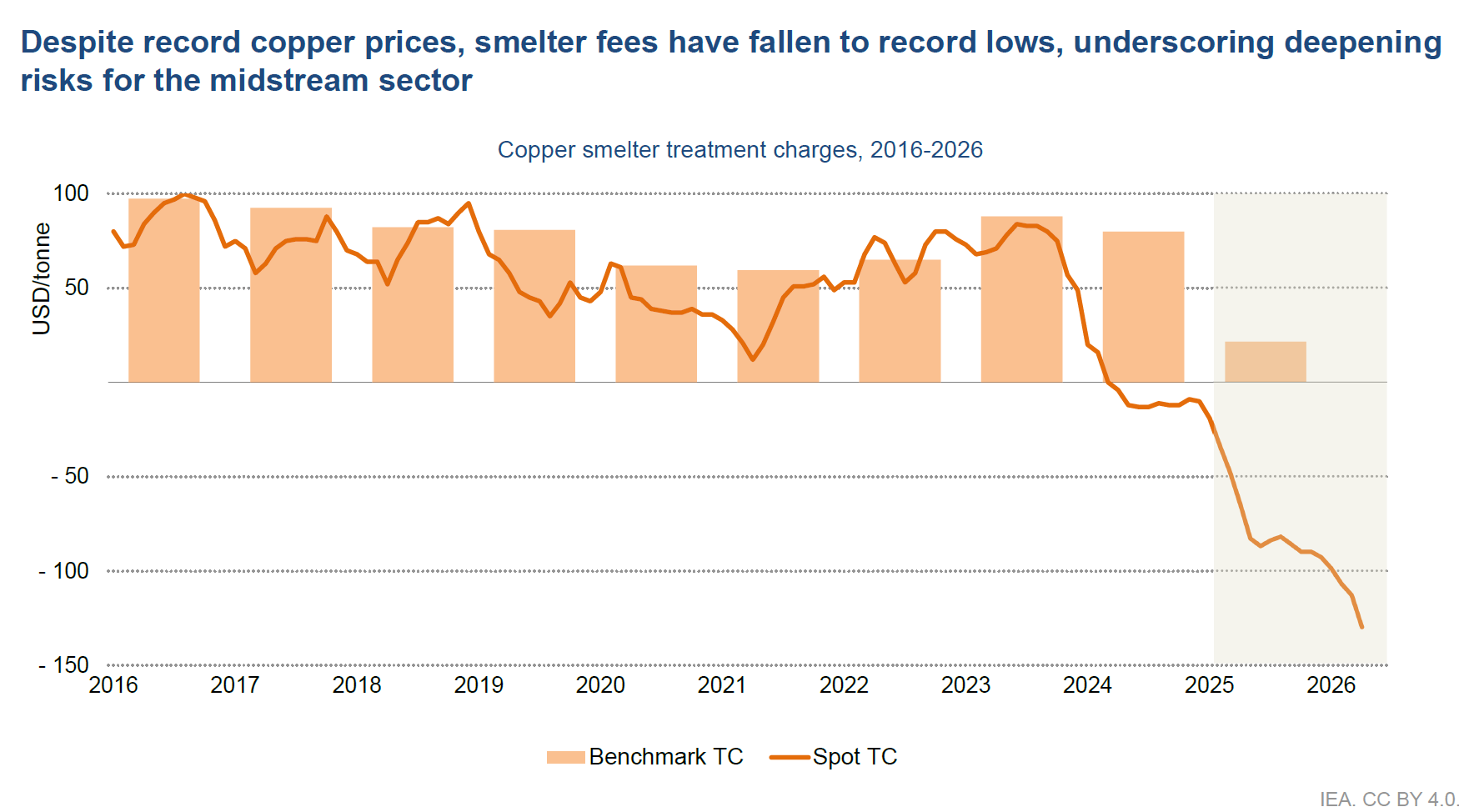
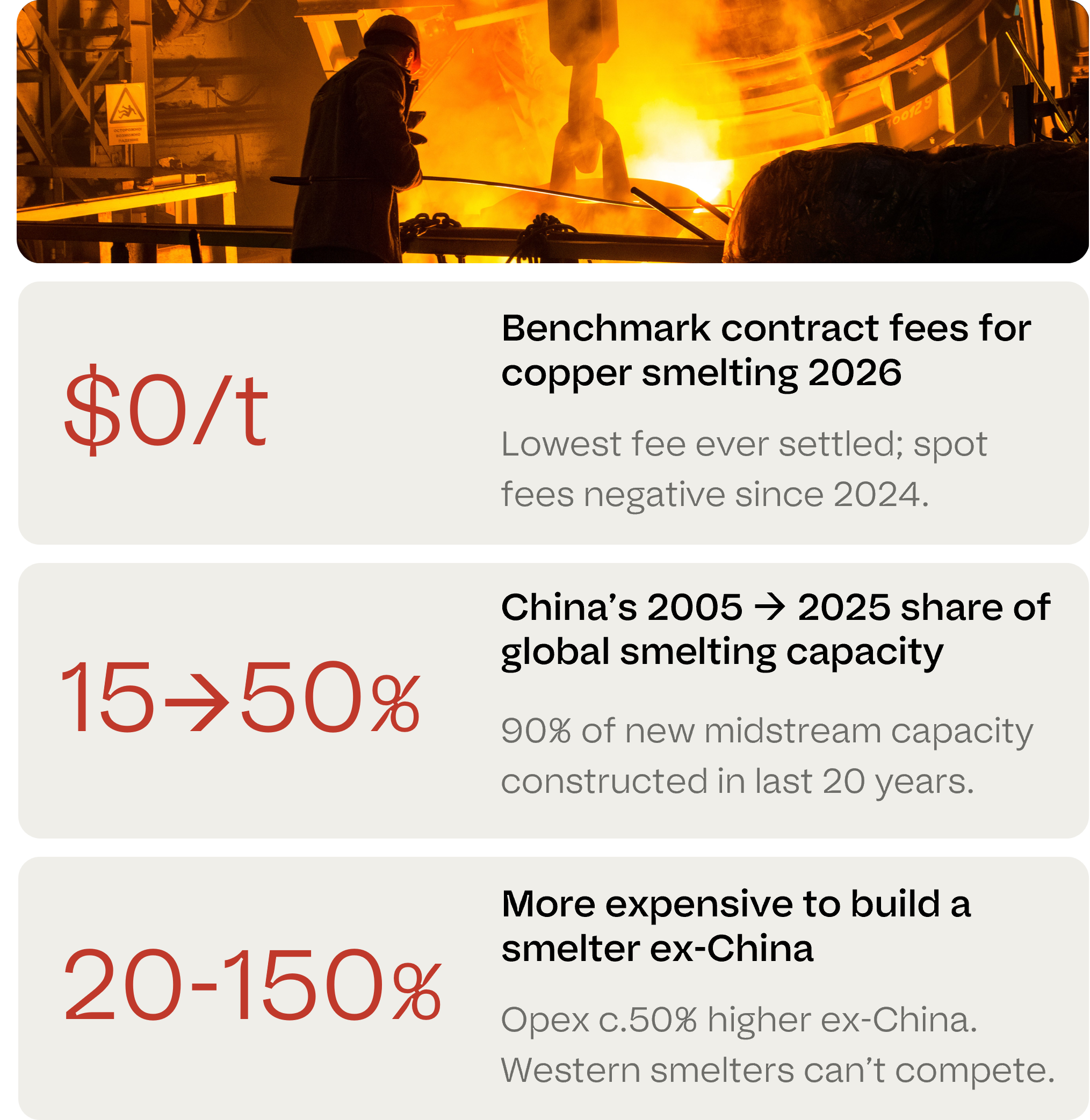
In January, the annual benchmark that sets what the world's copper smelters get paid to turn concentrate into metal settled at zero dollars a tonne. The lowest figure ever agreed. Spot charges have been negative since 2024. Zinc and lead fees have turned negative too.
That number comes from the IEA'sGlobal Critical Minerals Outlook 2026, and it deserves more attention than it has had. A treatment charge is the core revenue of a smelter: the fee it earns for the processing step itself. When that fee goes to zero, the business of custom smelting stops paying for the thing it exists to do. Smelters are now reliant upon but on by-product credits from gold, silver and sulphuric acid, not on processing. Sulphuric acid prices have surged due to the Gulf of Hormuz crisis, providing temporary reprieve to smelters but that is not a foundation to build new capacity on.
It would be easy to file this under commodity-market noise. It isn't. It's the clearest signal yet of a structural problem in the part of the supply chain almost no one campaigns about: the midstream. The place where ore becomes usable metal.
How one geography ended up owning the middle
The zero didn't appear by accident. Since 2005, China has accounted for more than 90% of the growth in global copper smelter output, lifting its share from around 15% to roughly half of world supply. That capacity was added faster than concentrate could be mined to feed it. Chase too much smelting capacity after too little feedstock, and the fee that capacity can charge collapses. It has.
The consequence shows up as a widening gap in who can actually keep the lights on. In 2020, smelters inside and outside China both ran at around 80% utilisation. By 2025 that had split: below 70% outside China, about 85% inside it. Underused assets earning nothing on their core service are not long for this world.
This is not a mining story. Diversify every mine you like, the chokepoint sits one layer downstream, in processing. And processing is where concentration is most acute. Excluding rare earths, the average share held by the single top refining country (no prizes to guess which one) hit 72% in 2025. Metals are not scarce. The capacity to refine them outside one country is.
The market is driving toward more concentration, not less
Here is the part that should reframe the whole debate. The IEA is blunt about where current conditions lead: if they persist, custom smelters outside China face growing economic pressure and may close, which wouldincrease supply concentration, not reduce it. Left to market forces, the system consolidates further into the geography that already dominates it.
And you cannot simply build your way out with more of the same model. Refining projects outside the dominant supplier carry capital costs 20% to over 150% higher, with operating costs around 50% higher on average. Every attempt to answer concentration by replicating the incumbent, capital-heavy, centralised plant runs straight into that penalty. It is precisely why the West keeps announcing capacity and precisely why so little of it gets financed.
There is one revealing exception in the data. The one refined category where concentration actually fell last year was rare-earth refining and only because of deliberate policy and investment support in the US and Malaysia. Diversification is possible. But it does not happen on its own. The default direction of travel is the opposite.
Do we subsidize our way to resilience?
There are two honest responses, and the mistake is treating either as sufficient alone.
The first is to defend the strategic smelters we have, through backstops, offtake support and price floors. The IEA is right that primary smelters are strategic hubs; concentrate still needs them, and letting them fail would hand over even more of the middle. That work is necessary.
But subsidy defends what already exists. It does not build thenewcapacity the energy transition requires, and it does barely anything for the fastest-growing feedstock, the secondary and complex waste streams that centralised smelting was never designed to process economically. That growth has to be served by a processing model with a fundamentally different cost structure.
The capital markets already sense the gap. Public finance committed to critical minerals in advanced economies passed USD 65 billion in 2025, over four times the 2023 level, aimed squarely at the midstream. In the same year, investment in the conventional, capital-intensive model fell 9%, the first substantial decline since 2020, even as demand grew around 10% a year. Money is retreating from the old cost structure while the need accelerates. That is the definition of an opening.
The West needs a new processing model
The answer to a capital-intensity trap is not more capital intensity. It is distributed, modular processing, capital-light plants deployed where the material is already generated, running at low temperature rather than on the economics of a billion-dollar furnace on a ten-year timeline.
This is the layer we are building at DEScycle. Using ionometallurgy, a low-energy, low-temperature route to metal recovery, we turn domestic waste streams into sovereign metal supply, starting with electronic waste, through standardised units designed to be replicated rather than engineered from scratch each time. The point is not that our plant is better than a smelter. The point is that it competes on a structurally different cost base, which means it can serve the distributed, secondary-feedstock growth that centralised smelting cannot economically reach. The big shift is that it can be built at home without the capex penalty that stops everything else.
The West does not have to choose between propping up smelters and doing nothing. But it does have to decide whether the next generation of processing infrastructure gets built domestically, or bought from the one place that already owns the middle. On current trajectory, the market makes that decision by default and its moving in the wrong direction.
Figures cited are from the IEA's Global Critical Minerals Outlook 2026.
News and Insights