Image credits: CC BY-NC-ND 4.0
Thought Leadership
Scaling deep tech in the UK: should founders be worried or optimistic?
2 Nov 2026
Scaling deep tech in the UK: should founders be worried or optimistic?
DEScycle sits at the intersection of two of the UK's biggest growth opportunities: critical metals and the circular economy. Last week's Budget moved significant capital behind the UK's public finance institutions (PUFINs).
So why are we worried about scaling in the UK?
Critical metals underpin every strategic bet in that Budget. AI, defence and electrification all run on copper, gallium, rare earths and precious metals. Meanwhile, WRAP's new Powering Good Growth report finds that bolder steps on the circular economy could add £93bn in GVA and 550,000 new jobs by 2035.
So deploying novel infrastructure that crosses both should be a no-brainer. Right? Especially as geopolitics shifts towards domestic production and the PUFINs have more capital than ever.
Not quite.
The UK is very good at funding discovery and demonstration. It is excellent at providing debt funding to derisked projects. What it still lacks is a reliable way to finance the step in between: the first-of-a-kind (FOAK) plant, the first commercial facility built on a new technology.
That is the step where a deep tech company stops being an R&D cost centre and becomes a manufacturing profit centre. It is also the step where UK companies most often leave.
Today, my honest answer is both. Optimistic about the ingredients. Worried about the bridge.
Why founders should be optimistic
- The PUFINs have real firepower. The Budget added £20.4bn across the National Wealth Fund (NWF) and British Business Bank (BBB), taking NWF's capitalisation from £27.8bn to £43.2bn. NWF will substantially increase its focus on defence, critical minerals and AI. Up to £5bn over four years is earmarked for defence, dual-use and national security.
- The demand signal is structural. Export controls, supply concentration and sovereign AI and defence ambitions all point the same way: more domestic processing capacity. The circular economy prize is £93bn. Today the UK is capturing almost none of that upside: circular economy jobs were flat between 2019 and 2024.
- The capital is already flowing in. The UK led Europe in cleantech investment between 2016 and mid-2024: 1,038 deals worth $15.25bn, ahead of Germany ($13.79bn) and France ($11.20bn), according to Cleantech for UK.
- The places to build exist. Clusters like Teesside combine shovel-ready sites, permitting experience, an industrial workforce and scale-up specialists like CPI. Our own demonstration plant at Wilton now processes UK electronic waste supplied by GAP Group.
The ingredients are here. The question is whether they connect.
Why founders should be worried
- FOAK falls between every UK funding model. Too late for grants. Too capital-intensive for most venture funds. Too risky for PE or commercial debt before revenues exist. And too bespoke for repeatable institutional investment.
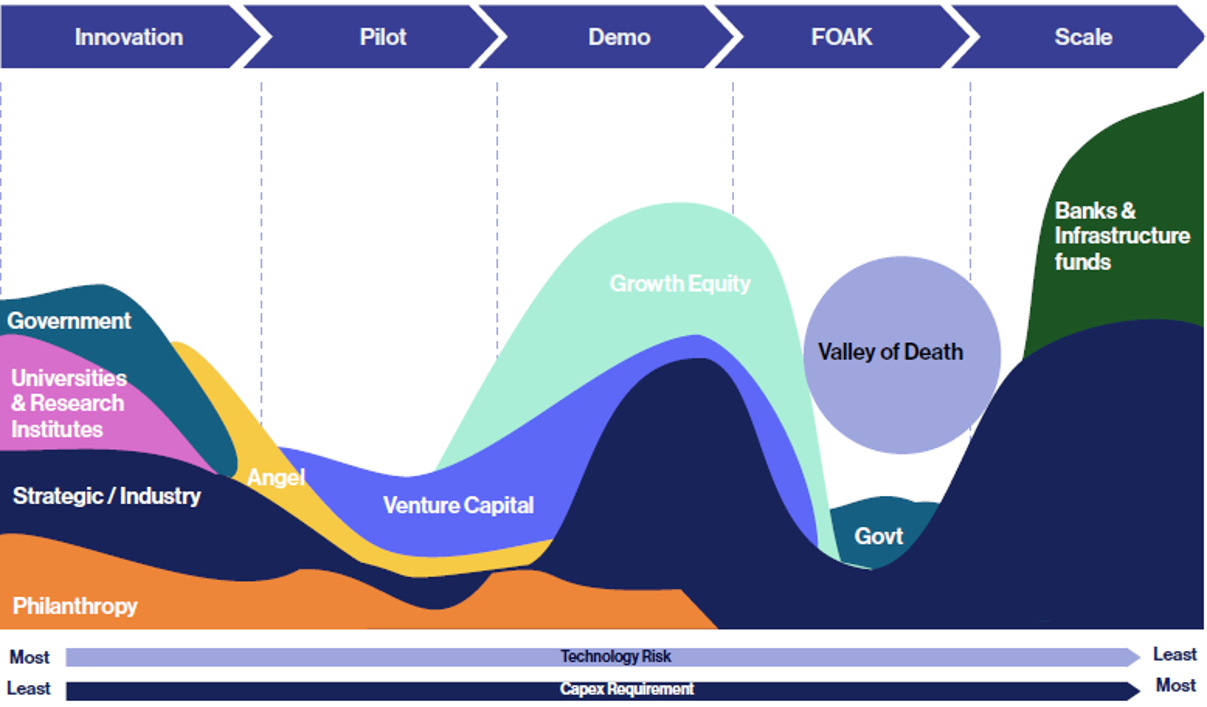
- Capital is priced on the company, not the asset. Lenders and investors assess a young company's balance sheet and track record, not the cashflows of the plant it wants to build. So the UK can de-risk a technology through demonstration and still fail to finance the first commercial asset.
- So companies follow the money. Cleantech for UK found that 50% of recent investments in UK FOAK projects came from strategic investors, against 22% for other large cleantech deals. Only 5 of 26 of those strategics were UK-based. Despite leading Europe on deal volume, the UK lags France and Germany on getting capital-intensive FOAK projects built. We have seen this film before: the UK deployed offshore wind at scale and never built the domestic manufacturing base.
Here is the part that should reframe the debate. Energy cost is usually blamed when UK FOAKs move abroad. However, as a founder, my argument is that capital financing is by far the bigger factor. That is a problem the UK can actually fix.
But the Budget didn't fix it. Neither the Budget Report nor NWF's statement included a ring-fenced allocation or a FOAK mandate. Without this specific mandate the UK’s PUFINs simply won’t take the capital risk. Capital allowances were tweaked but not made payable, so a pre-profit company building its first plant still gets no cash from them.
For founders and VCs: finance the plant, not the company
(Hope) waiting for policy is not a strategy. The founders getting first plants built are changing what they ask investors to underwrite.
- Build a blended stack. European FOAK stacks are roughly 25% public grant, 25% public backed loan and 50% private capital. Every layer prices risk differently, so design the stack early. For UK founders, this may mean replacing the 50% public backed elements with private capital, but that doesn’t mean equity if you get creative. Pre-payments, streams, royalties, venture debt and asset finance can all play a roll.
- Bring revenue certainty before capital. Offtake agreements and strategic partners turn a science project into an infrastructure asset. Strategic investors are already half of UK FOAK funding. The difficulty is that most strategics aren’t based in the UK and want FOAK’s built in their home markets.
- Choose your cluster deliberately. Shovel-ready sites, permits, grid and skills can cut months and millions from a first build. If you’re looking at a site without the power connection you need, forget it. Power connections can take years in the UK, even for major “strategic” projects (Microsoft pulls out of UK Nscale data centre deal over power delay | Reuters).
- Sell the scaling story, not just the plant. Plants two to N are where returns compound. A credible first plant is the bankability event that unlocks project finance for the rest.
For VCs, the opportunity is mispriced risk. Where technology risk has genuinely been retired at demonstration scale, FOAK is being priced like a science project rather than an engineered scale-up asset. That gap is where returns are.
For government: give the PUFINs a FOAK mandate.
The capital is there. The risk appetite isn't. Founders can do a lot, but only government can change who carries first-plant risk.
This is not a new ask. In 2024, Cleantech for UK called for a dedicated FOAK workstream inside the National Wealth Fund, unlocking £500m a year and leveraging 3x private capital. Two years and £15bn of extra NWF capital later, there is still no ring-fenced or mandate for FOAK projects.
What would change that:
- An explicit FOAK mandate with dedicated capital at NWF and BBB.Project-level instruments: first-loss capital, subordinated loans and partial guarantees that sit alongside private capital.
- A repeatable platform, not bespoke deals. A standard pipeline, diligence process and capital stack that decides in months, not years.
- Upside for the taxpayer. Equity returns from shares in rapidly scaling companies, return on capital provided as debt, so one-off support becomes long-term value, even if later plants are built abroad. Most importantly, UK tech companies can anchor here, rather than be forced abroad to scale. This means UK growth, more jobs, more tax revenue and a pipeline of companies for the LSE.
- Bankable revenues for critical minerals. The Vision 2035 target of 20% of demand from recycling needs mechanisms: strategic offtake, procurement commitments, a price-linked floor modelled on Ofgem's cap-and-floor regime, and WEEE reform that rewards recovering metals in the UK.
- Payable or transferable capital allowances, so pre-profit companies get cash when they build.
Others are not waiting. France 2030's première usine programme exists specifically to back companies building their first production plant in France. The US has a 10-year, $110/kg price floor for MP Materials' rare earth output. The EU is has banned critical metal scrap exports and is deploying €3bn into critical metals.
So, worried or optimistic?
Optimistic, conditionally.
The UK has the science, the waste streams, the clusters and, after this Budget, more public capital than ever. What it lacks is a bridge from demonstration to first commercial plant. Build that bridge and WRAP's £93bn starts to look like a plan rather than a forecast. Leave it, and the first plants get built somewhere else.
The UK pays to discover, develop and de-risk new technologies. The question now is whether it deploys the factories at home or keeps losing them abroad.
Building in the UK needs to be the logical commercial choice, not just the patriotic one.
Founders, investors, and anyone at NWF, BBB, DBT or Treasury: what would make your next first plant a UK plant? I'd like to hear from you.
Sources
- HM Treasury, Budget 2026 (HC 726), paragraphs 2.53–2.54, 4.43–4.46, 4.97, 4.101–4.102, 4.116, 6.251 and 6.257
- HM Treasury, CGT Founders' Relief: technical consultation (October 2026), paragraphs 2.5, 2.7 and 3.2
- National Wealth Fund, statement on Budget and additional capitalisation (28 October 2026)
- WRAP, Powering Good Growth, via letsrecycle.com and Fresh Produce Journal
- Cleantech for UK, FOAK: Powering Up the UK's Cleantech Advantage
News and Insights
Related news
Thought Leadership
The number the West should be worried about is zero.
Read more
Thought Leadership
Is the UK reforming permitting?
Read more
Thought Leadership
Trump Says US to Impose 50% Tariff on Copper Imports
Read more
Thought Leadership
Power Struggle: AI, Smelters & the Future of Energy Use
Read more